Compact before the flood
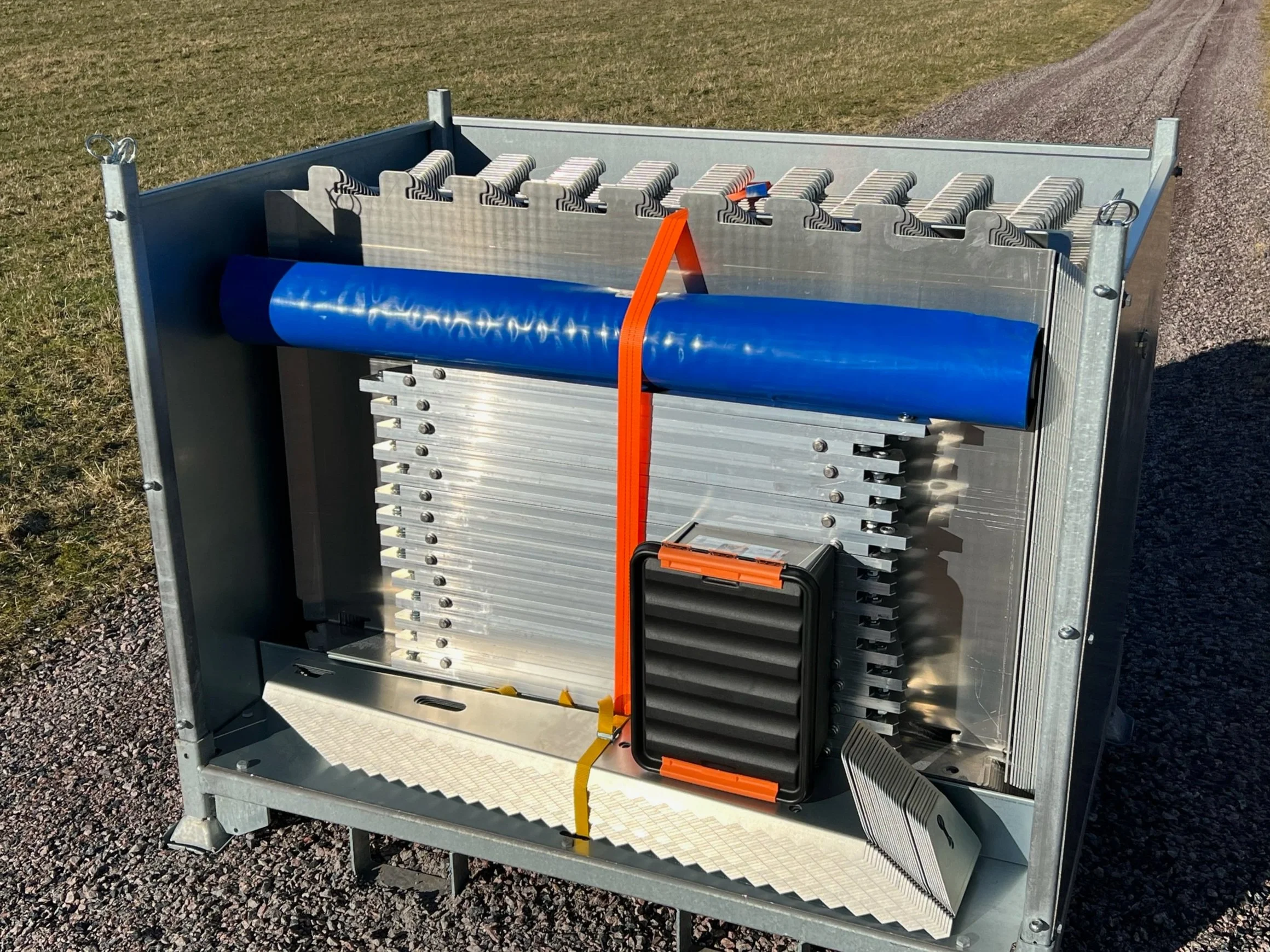
H50 and H80 are packed as 100 m per crate, H100 as 50 m and H150 as 25 m. The stackable steel crate system turns barrier capacity into a stockpile that can be counted, moved and staged.
 Criteria Explained
Flood barrier criteria, explained
Inero Barrier Compare turns mobile flood protection into measurable criteria. This page explains what each visible criterion means, how it is assessed, and why Inero performs strongly as a robust, reusable and versatile emergency flood barrier.
What the comparison is really measuring
Want to calculate a result?
This page explains the criteria and the Inero advantages behind them. The comparison tool lets you enter a barrier's storage, transport, leakage, robustness, handling and terrain values and see the grade against Inero H50, H80, H100 or H150.
Inero results in plain language
H50 and H80 are packed as 100 m per crate, H100 as 50 m and H150 as 25 m. The stackable steel crate system turns barrier capacity into a stockpile that can be counted, moved and staged.
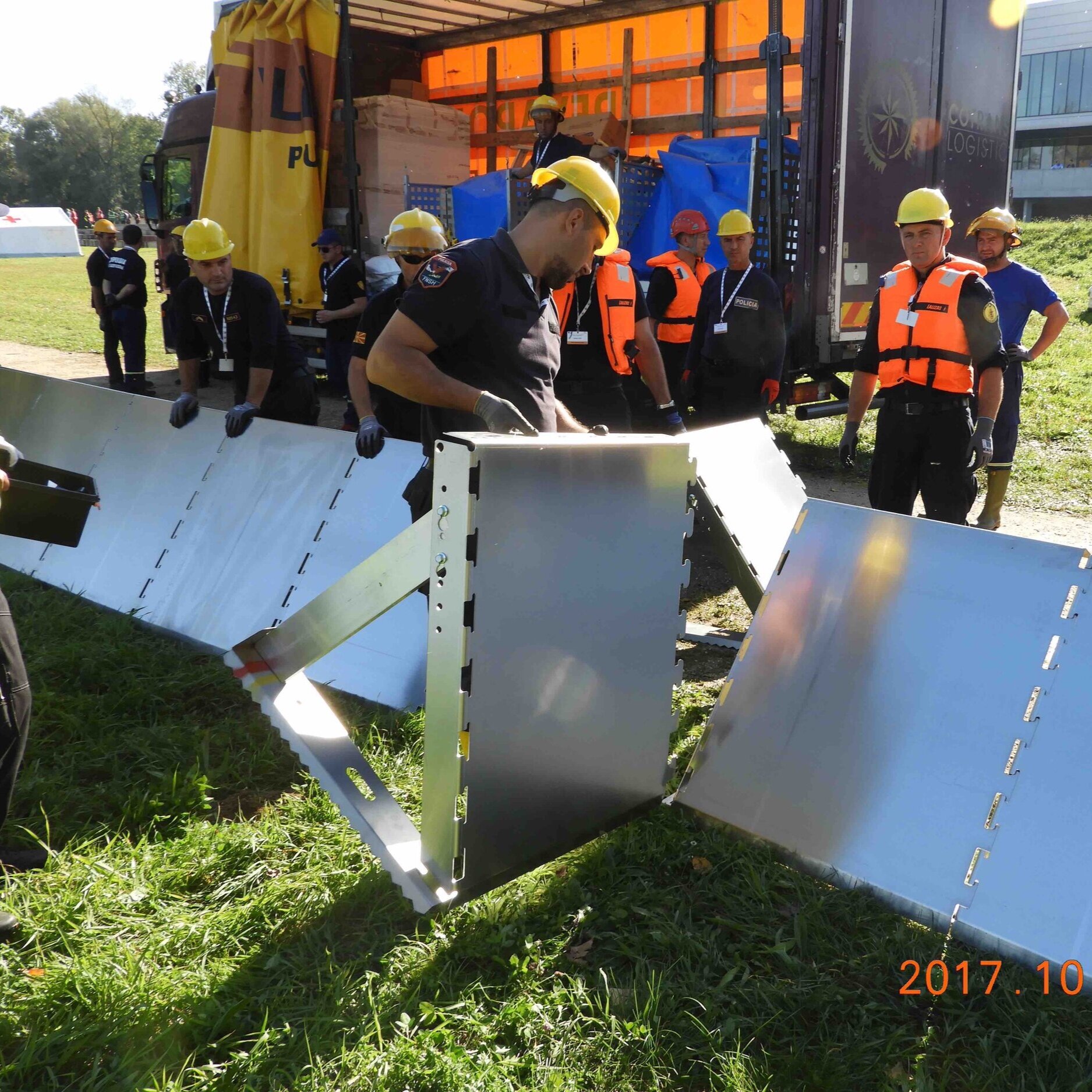
Pre-mounted bolts, few main part types, standard handling equipment and intuitive assembly reduce the chance that a response is slowed by sorting, measuring, missing parts or specialist tools.
Solid-panel construction, patented interlocking, debris impact evidence, high tensile strength, strong crest loading and safety-factor calculations provide margin under pressure.
Marine-grade aluminium, rinse-and-reuse workflow, recyclable materials and long service life mean the barrier remains an asset rather than becoming a single-use emergency cost.
The connector is central to the grade
The quick connector is more than a fastening detail. It helps sections become a continuous line, enables controlled overlaps and height transitions, supports terrain adaptation, and makes deployment easier for crews who do not have time for complicated assembly. This is why Inero's advantages appear repeatedly across the criteria rather than only in one category.
The visible comparison criteria
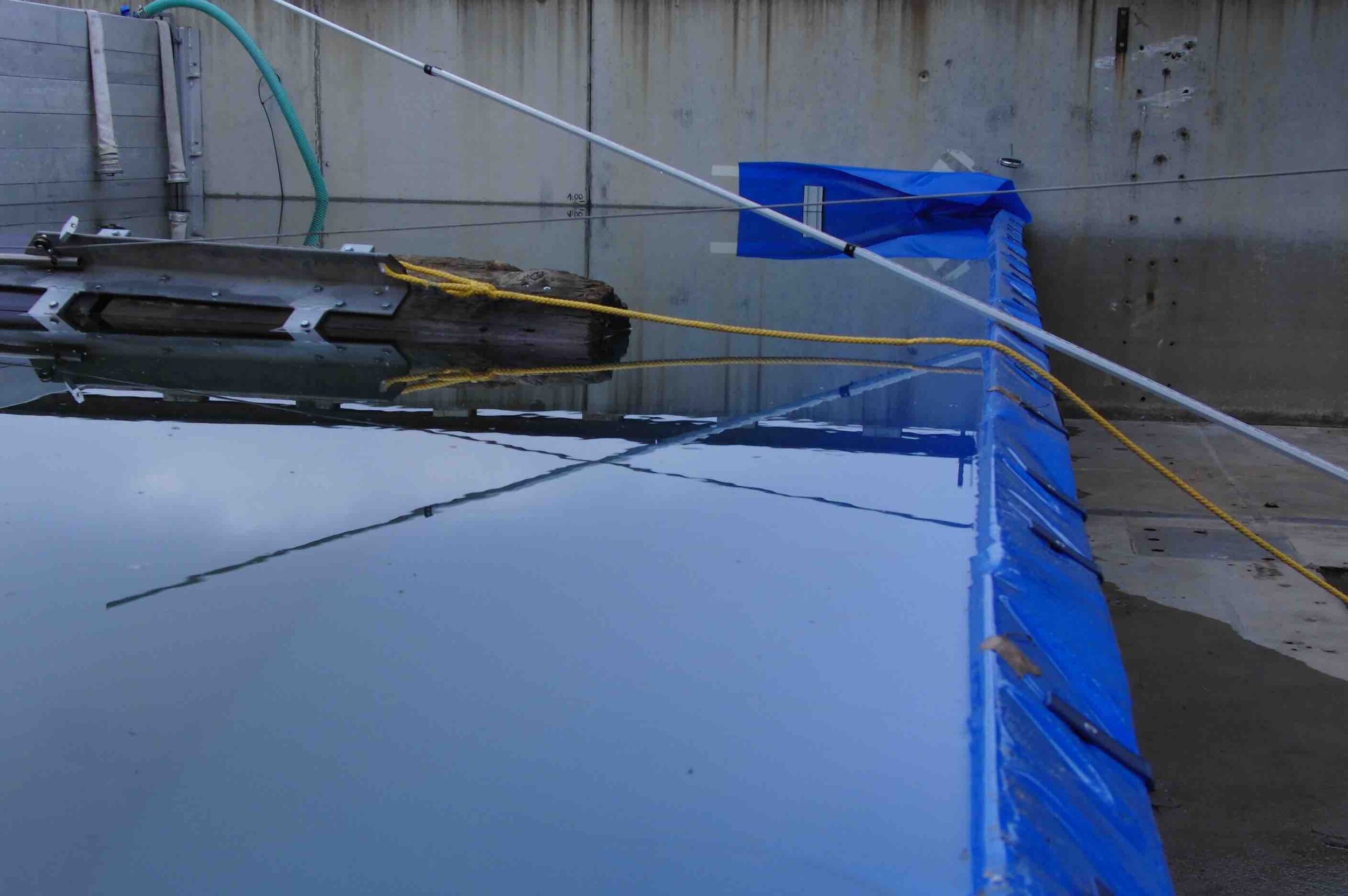
Leakage measures how much water passes through or under the barrier under steady hydrostatic load. Lower leakage means less pump capacity, less power demand and less residual water damage behind the line.
Inero pro: the H100 reference value of 38 L/m/h reaches the top grade in the comparison, and the solid-panel system avoids inflation or bladder failure modes that can suddenly increase leakage.
HASE measures how much protected barrier length can be stored per cubic metre, adjusted for barrier height. It rewards systems that fit meaningful protection capacity into compact crates rather than spreading parts across bulky packages.
Inero pro: nested sections and compact crate geometry make Inero easy to stockpile. H80 gives 100 m per crate, while H100 retains strong volume efficiency at 50 m per crate despite its higher protective height.
HAFE measures how much protected length can be stored per square metre of floor area, adjusted for barrier height and stackability. It asks whether a warehouse or depot can hold useful response capacity without sacrificing excessive floor space.
Inero pro: stackable steel crates make Inero practical for preparedness stockpiles. Using up to four crates within the 5 m stack-height rule gives strong HAFE results: H50 88.9, H80 167.3, H100 130.7 and H150 88.9.
CHTE-20 asks how much protection can be moved in a 20 ft container, adjusted by barrier height. It matters when regional stockpiles, disaster agencies or contractors must move large capacity quickly.
Inero pro: H80 logistics are described at 1400 m in a 20 ft container, while H100 reaches a three-star CHTE reference of 700. That means more usable flood line can be shipped before a storm peak arrives.
Deployment rate measures installed barrier length per person-hour under representative conditions. It is a practical criterion because warning time, night work, fatigue and staffing are often the limiting factors.
Inero pro: upright crate storage, pre-mounted bolts, quick connectors and no powered-tool dependency reduce the hidden time losses that slow many temporary systems.
This criterion checks whether the barrier can still be installed after water has already arrived. A good emergency system cannot require a perfect dry start.
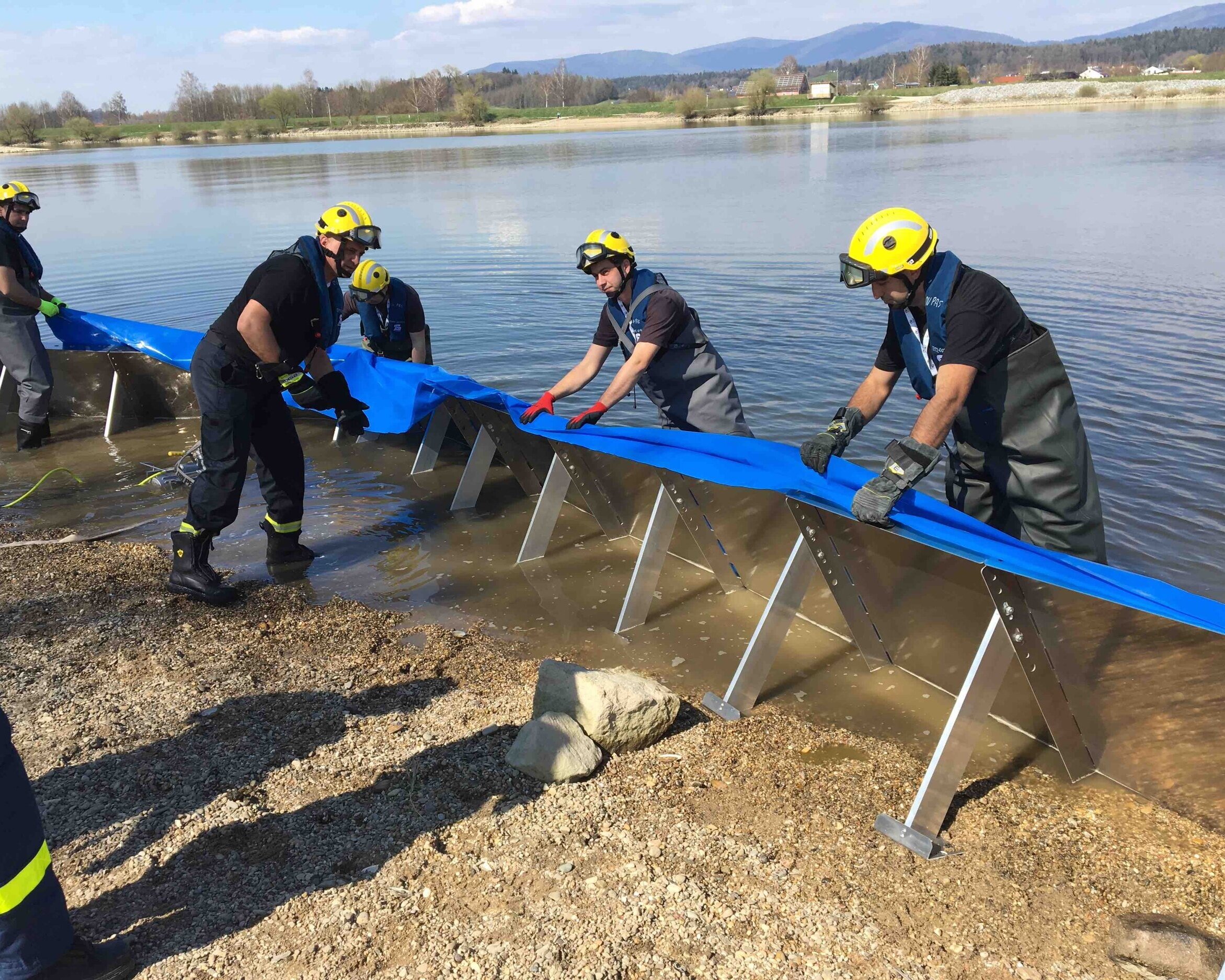
Inero pro: Inero can be deployed from the dry side in partially flooded areas without putting hands under the waterline, extending the safe deployment window.
Readiness looks at manpower, sorting, tools, loose parts, packaging and repacking. High readiness means a barrier is usable by real crews under weather pressure.
Inero pro: the system is packed as a deployment-ready workflow with few main parts, pre-mounted smaller components, light individual elements and straightforward return to the crate.
Terrain adaptability assesses curves, elevation changes, kerbs, obstacles, wall endings and sealing on non-perfect ground. It is essential for a disaster barrier because the exact site may be unknown.
Inero pro: overlapping sections, quick-link technology, corners, wall fastening and adjustable installation logic let Inero follow real streets, riverbanks, entrances and infrastructure edges.
Debris impact resistance measures the energy a barrier can withstand without failure, displacement or loss of integrity. Flood water often carries logs, containers, street furniture and other sudden loads.
Inero pro: the solid, angled construction and full-scale impact evidence give Inero a strong advantage over systems that depend on air pressure, water fill or weak vertical panels.
Tensile strength targets joint separation, tearing and load transfer in long connected runs. A barrier line is only as reliable as the connections between sections.
Inero pro: the H100 reference of 72 kN/m is a top-grade result. The patented locking mechanism distributes load across the line rather than leaving the joint as the weak point.
Safety factor measures margin across stability, members, connectors, joints and anchors where relevant. It protects against uneven ground, installation variation, debris and water levels beyond clean assumptions.
Inero pro: H100 references a 2.7 safety factor, and the complete overview describes calculated safety factors above 2 for all barrier sizes.
Crest loading measures whether the top of the barrier can support concentrated loads such as hoses, pump lines or occasional personnel contact without structural damage.
Inero pro: the H100 reference of 200 kg supports demanding pumping and emergency operations, where a barrier often becomes part of the worksite.
Tamper resistance assesses whether secured sections can be removed, opened or disassembled by unauthorized people. Public-facing flood lines may stand unattended.
Inero pro: interior sections can be secured so removal requires powered metal tools or specialist equipment, improving physical security in urban and infrastructure deployments.
Deployment cycles measure repeated full deployment, loading, dismantling, cleaning, repacking and return to storage-ready condition. It matters for training as well as repeated emergencies.
Inero pro: the system is built for reuse, with rinse-and-repack workflow, durable components and declared reuse potential that supports drills, seasonal risk and multiple flood events.
Service life measures how long the system remains operational. Long life changes the economics from emergency expense to durable civil-protection infrastructure.
Inero pro: marine-grade aluminium, recyclable components and a 30-50 year design horizon help reduce replacement cost, storage waste and total lifecycle cost.
Visual proof points
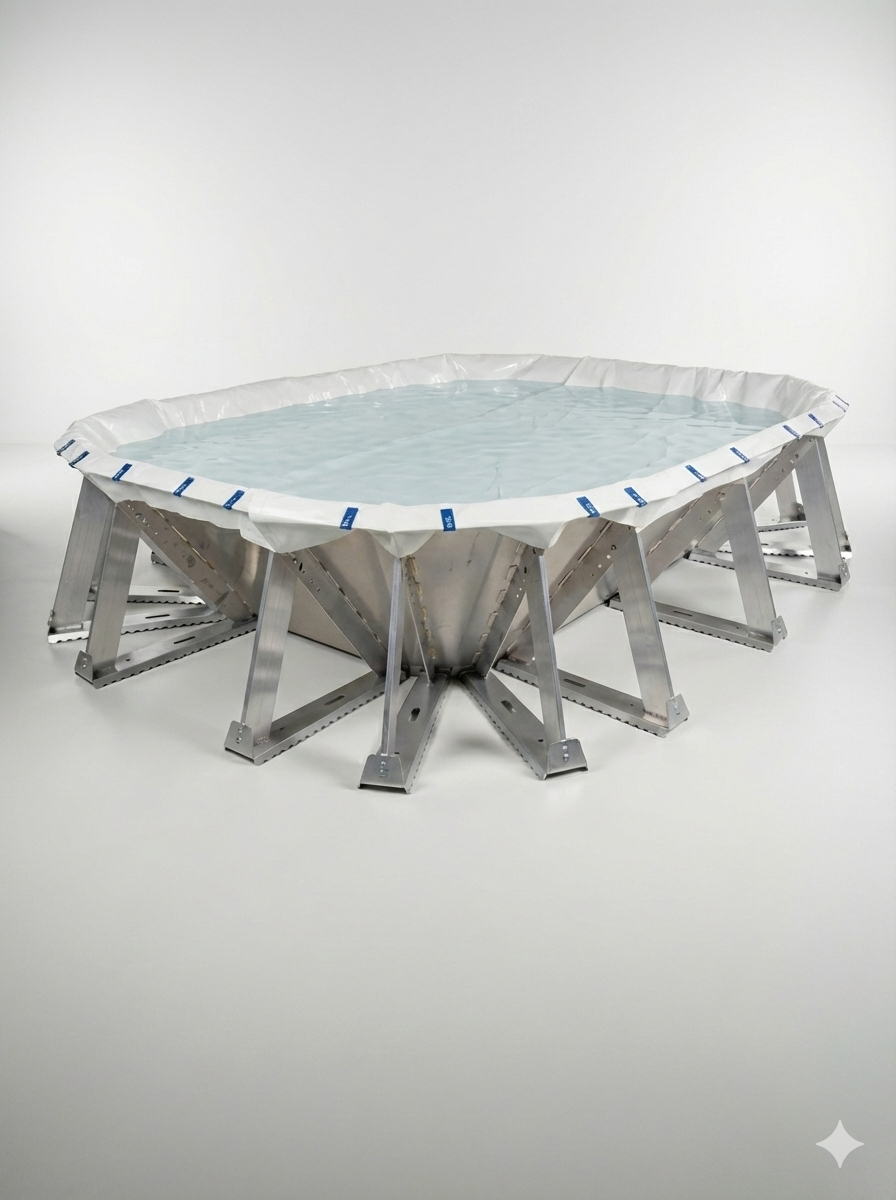
Inero model family
| Model | Protective height | Stored length | Best fit |
|---|---|---|---|
| H50 | 50 cm | 100 m/crate | Lower water levels, urban cloudburst response and quick protection. |
| H80 | 80 cm | 100 m/crate | High-capacity emergency stockpiles with excellent logistics density. |
| H100 | 100 cm / 120 cm with extension | 50 m/crate | Strong comparison reference with excellent leakage, transport and robustness values. |
| H150 | 150 cm / 170 cm with extension | 25 m/crate | Higher water exposures where the same modular field logic is needed. |
Track record
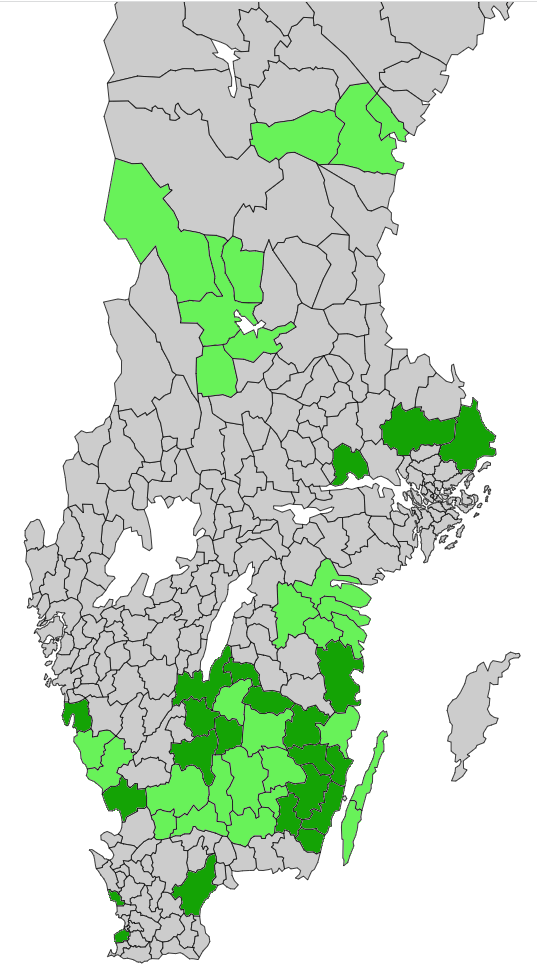
Inero has been selected across Europe, Asia and North America, including municipalities, emergency services, waterworks, transport hubs and industrial sites. The feature overview also states that national and local governments in the United Kingdom, France and Sweden have chosen Inero solutions.

Compare with confidence